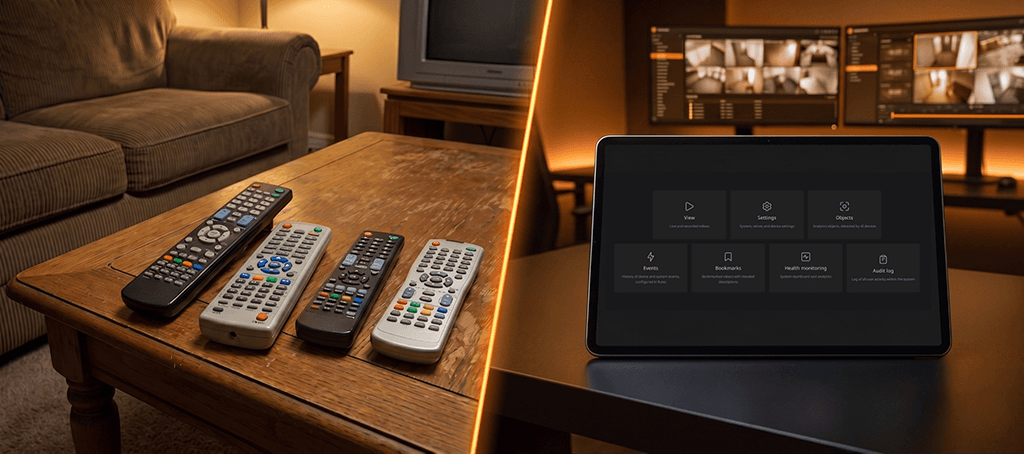
Picture your parents' or grandparents' living room. A coffee table cluttered with three or four different remotes: one for the TV, another for the set-top box, a third for the DVD player (do you remember DVD?), and a fourth for the audio system.
Then came the moment they simply wanted to watch the evening news. It triggered a complex dance: "Turn it on with the black one, switch the HDMI with the grey one, adjust the volume with the long one." One wrong button, and the entire system crashed, leaving static or a stark "No Signal" message on the screen.
And how did manufacturers respond? By adding even more buttons and complexity, often with little consideration for the end user.
Did it help? No, it only deepened the frustration. Technology only won when someone discarded 90% of the keys, leaving a minimalist controller.
For years, the security industry has faced a similar challenge. Many Video Management Systems (VMS) have grown over time to resemble those old, button-heavy remotes. A client says, "I want to quickly find footage and see who moved the pallet in the warehouse." In response, they receive a system with an interface resembling an overloaded aircraft cockpit. Designers forget that at the end of this process, there is always a human. An operator who just wants to get the job done. Quickly, smoothly, and without panic.
A VMS is not just "windows for viewing cameras"; it is the brain of the entire operation. It is time to rethink how we choose it.
Fewer Buttons, More Action: An Interface That Stays Out of Your Way
That is exactly why the Hanwha Vision BLAZE platform was designed to be that perfect, minimalist remote control. Instead of scattering tools and forcing the operator to jump between disconnected applications or hidden menus, we consolidated everything into a single, ergonomic window divided into logical blocks.
The interface relies on tabbed navigation, much like a standard web browser. Need to switch from a live view to an interactive map or the AI metadata database? It takes just one click. We also discarded rigid, predefined viewing grids. You simply drag cameras onto the screen, and they automatically adapt to the available space. Even fisheye camera dewarping is handled intuitively with a simple scroll of the mouse wheel. The entire architecture is engineered for full multitasking, ensuring the operator never gets lost in a maze of features.
However, this frontend simplicity is only the tip of the iceberg. The true revolution lies deeper, within the core IT architecture.
The IT TCO Paradox: The Illusion of Upfront Savings
When planning project budgets, it is easy to compare numbers in an Excel spreadsheet. You see the cost of a single-channel license and think, "I'll choose this system and save money." This is a fundamental mistake. The license price is merely the tip of the iceberg. The true Total Cost of Ownership (TCO) lies beneath the surface, hidden in hardware requirements, server maintenance, infrastructure, and deployment time.
Most traditional systems place a heavy demand on hardware resources. To support advanced analytics, you must invest in massive servers. Furthermore, the market has conditioned us to accept an Active-Standby failover architecture. You buy a second, equally expensive server that sits idle, waiting for the primary one to fail. You invest in hardware that remains largely idle, consuming rack space, power, and budget while waiting for a failure that may never occur.
Hanwha Vision’s BLAZE platform takes a fundamentally different direction. It is designed around a native End-to-End architecture. The camera with AI analytics and the VMS understand each other perfectly, straight out of the box. Instead of wasting your budget, BLAZE introduces Active-Active failover clustering. You deploy multiple servers, and every single one is actively working. If one fails, the cameras are automatically—and completely invisibly to the operator—redistributed across the remaining machines. Zero wasted capacity.
For designers of enterprise-level systems, this provides a powerful foundation: a single server supports up to 256 devices, and within a cluster, the system scales up to 12,800 channels. Managing distributed sites? You can effortlessly link them into a cloud federation. Crucially, when modernizing existing setups, you can forget about vendor lock-in. Comprehensive support for established ONVIF standards, RTSP streams, and a robust open API allows you to seamlessly integrate legacy infrastructure, while the platform's future-proof architecture is built to effortlessly adopt emerging protocols.
Even the licensing model is straightforward. One license equals one camera. However, if you connect IP speakers or intercoms, a single license covers up to four devices. When integrating an NVR, one license covers eight channels. This hardware optimization combined with a flexible licensing approach ultimately delivers a significantly more cost-effective and stable deployment.
Operator Time as the Rarest Currency: AI in Practice
The most expensive component of any security system is human time.
Imagine a logistics center with non-stop vehicle traffic. On a traditional VMS timeline, vehicle object detection generates a single, solid block of colour. Three days later, a manager asks: "Two days ago, the barrier jammed and caused a backlog. I need to know exactly when it happened." The operator is faced with hours of tedious, manual footage scrubbing.
BLAZE solves this problem with a feature inspired by professional video editing. When synchronizing multi-camera tracks or cutting footage to a musical beat, editors do not watch the entire video; they rely on the audio waveform to instantly locate specific sound cues. Applying a similar principle to video analytics, BLAZE transforms thousands of detections into an interactive event histogram. Instead of searching blindly, operators can immediately spot anomalies (a sudden "spike" on the graph) and jump directly to the relevant seconds of the event with a single click.
Furthermore, the upcoming hardware-based P series Blaze Appliance will take this a step further by introducing Semantic Search. Powered by generative AI, this engine will let operators query archived video using natural language rather than relying on limited, predefined metadata. Instead of filtering by fixed attributes, you will simply type "woman holding a phone", and the system will understand the context to return precise results. This is no longer just reviewing footage. It is indexing reality.
Cybersecurity: A Make-or-Break Business Imperative
We live in an era where physical security systems are an integral part of IT infrastructure and are subject to stringent audit requirements. The NIS2 Directive and the Cyber Resilience Act (CRA) leave no room for compromise.
BLAZE addresses these challenges at every layer of the network. From encrypted camera communications to tamper-resistant exported clips and intelligent session management, the entire system is rigorously secured. With automatic HTTPS negotiation and JWT-based authentication, BLAZE meets the rigorous IT security standards. From an operational standpoint, the system also features a chronological Audit Log that records every user action.
The true breakthrough, however, is the Blaze Appliance. This is a turnkey hardware unit running a closed Hardened OS. The administrator only interacts with the VMS interface; there is absolutely no access to an open operating environment that could serve as an attack vector. The device complies with FIPS 140-3 Level 3, ensuring robust cryptographic protection. Ultimately, the end customer receives hardware designed for the most demanding environments.
Conclusion
Customers do not invest in software for its own sake; they invest in solutions that save time, reduce complexity, and deliver operational value. BLAZE was created to give that time back.
Whether you deploy pure software on your own servers or opt for the turnkey Blaze Appliance, which you unpack, connect, and start using immediately—you receive a unified ecosystem. It offers powerful capabilities that do not require reading a thick manual. In security systems, the best solutions are maintenance-free, stable, and intuitive. That is precisely what BLAZE is.
Want to see how BLAZE can handle your project and actively lower your investment TCO? Contact us today to schedule a live system demonstration, or sign up for our recurring on-site training sessions to personally test the ergonomics and the power of Hanwha Vision’s AI analytics.
Previous
Next