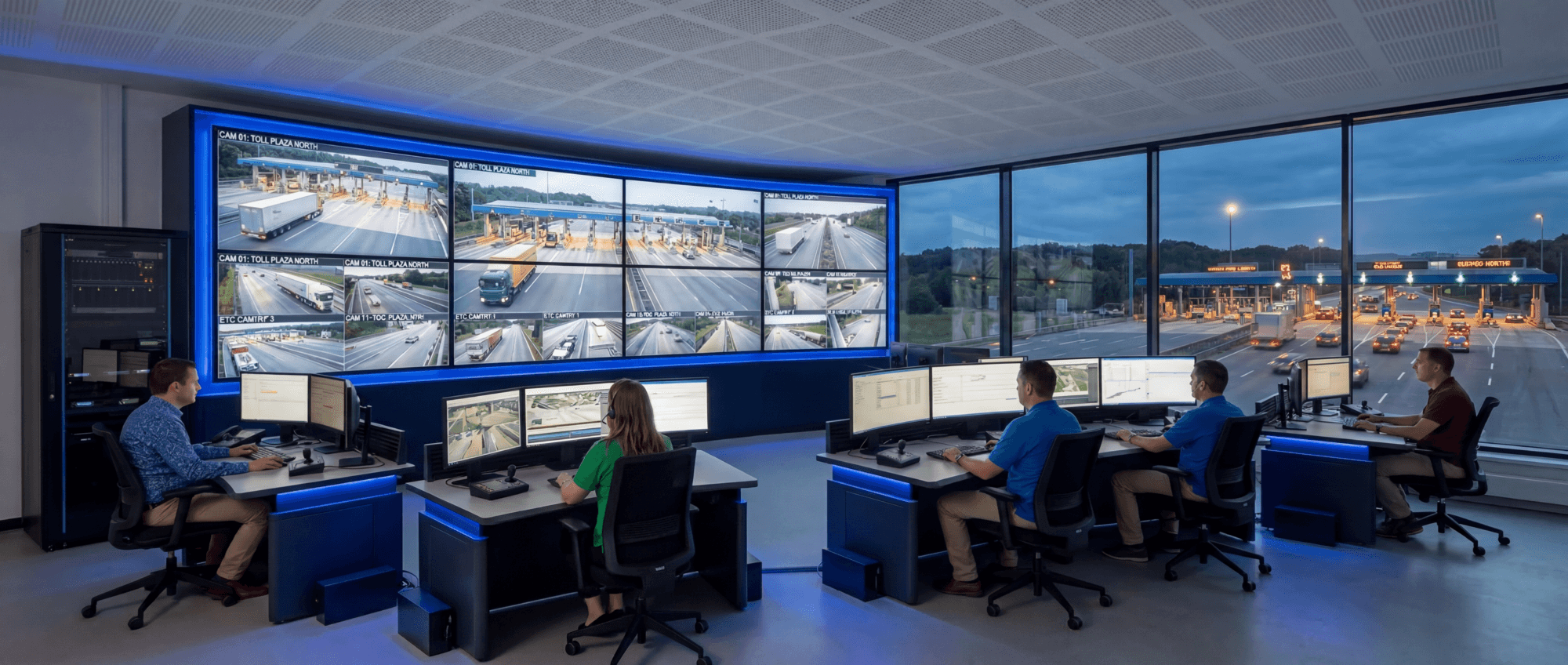
More than 42,000 people are killed in traffic crashes each year in the United States, according to Vision Zero Network. As pressure to improve roadway safety grows, localities need to detect risk earlier, respond faster to incidents, and proactively design safer streets.
This shift is accelerating the adoption of smart city strategies that connect cameras, analytics, and traffic systems into a single real-time operational view.
License plate recognition (LPR) cameras provide a critical data layer by capturing vehicle data that supports monitoring, incident response, and long-term planning. Understanding how LPR cameras work and how they fit into Road AI, intelligent transportation systems (ITS), and smart city surveillance programs is essential for building safer and more responsive roadways.
Key Takeaways
LPR cameras capture license plate data for traffic, safety, and access control.
Different LPR camera types support fixed and mobile use cases.
Performance depends on resolution, lighting, shutter speed, and analytics.
Installation and integration affect capture reliability.
What Are LPR Cameras?
License plate recognition (LPR) cameras are specialized surveillance systems that capture vehicle plate images and convert them into structured data using onboard processing and optical character recognition (OCR). These systems can trigger alerts, log vehicle activity, and connect with access control or enforcement platforms in real time.
Unlike general-purpose cameras, LPR cameras are engineered to accurately read plates under various speeds and lighting conditions. In smart cities, they feed license plate data into connected transportation systems to enable real-time monitoring, automated enforcement, and strategic traffic planning.
What Are LPR Cameras Used For?
LPR cameras support a wide range of transportation, public safety, and security initiatives by capturing and analyzing license plate data in real time. While LPR technology is often associated with smart city infrastructure, it is also deployed across several other operational environments that rely on automated vehicle identification.
Most deployments fall into four core categories:
Law enforcement and public safety
Smart city
Traffic and parking management
Commercial and Private Security
Law Enforcement and Public Safety
Crime solving: LPR cameras help law enforcement identify vehicles connected to criminal activity by matching license plate data against active cases, Amber Alerts, or stolen vehicle databases.
Investigation: Time-stamped license plate records allow investigators to trace vehicle movement before and after incidents, to help establish timelines and corroborate evidence.
Prevention: Continuous vehicle monitoring increases the likelihood of early detection, which can deter repeat offenses and reduce opportunities for vehicle-related crime.
Smart City, Road AI, and ITS
Smart street monitoring: LPR camera systems contribute to Road AI and ITS by tracking vehicle flow to help cities understand traffic behavior and congestion patterns.
City surveillance: Integrated with broader surveillance systems, LPR technology enhances visibility in high-traffic and high-risk areas by identifying vehicles of interest within intelligent transportation networks.
Incident detection: Real-time plate capture supports faster identification of stalled vehicles, accidents, or unauthorized access in restricted zones.
Data-driven urban planning: Aggregated license plate data feeds into smart city analytics, helping planners make informed infrastructure and transportation decisions aligned with long-term ITS goals.
Traffic and Parking Management
Automated tolls: LPR cameras enable toll collection without physical tags or gates by accurately identifying vehicles as they pass designated points.
Parking enforcement: Parking teams use license plate data to verify permits, monitor time limits, and reduce the need for manual inspections.
Traffic violations: Authorities rely on LPR systems to document violations such as restricted-lane use, expired registrations, or unauthorized entry.
Commercial and Private Security
Access control: LPR cameras support vehicle-based access control by allowing entry only to authorized plates at secured facilities.
Retail security: Commercial properties use license plate data to monitor repeat vehicle activity and support investigations tied to theft or safety incidents.
Types of LPR Cameras
LPR cameras come in several forms, each designed for specific operational environments and deployment needs. Understanding these distinctions helps agencies and organizations select the right solution for their application.
Automatic license plate recognition (ALPR) cameras
License plate capture (LPC) cameras
IP license plate cameras
Handheld tag reader cameras
1. Automatic License Plate Recognition Cameras
Automatic license plate recognition cameras add software-driven automation to the capture process. They automatically extract plate numbers, timestamps, and location data without manual review. ALPR systems are widely used by law enforcement and transportation agencies that need continuous, unattended monitoring.
2. License Plate Capture Cameras
License plate capture cameras are built to record clear, high-contrast images or video of license plates without performing automated recognition or analysis. Their primary function is visual documentation, producing footage that can be reviewed manually after an incident or event.
These cameras are typically used in locations where image clarity matters more than real-time intelligence, such as gated communities, commercial properties, or private roadways that need reliable forensic evidence rather than searchable vehicle data.
3. IP License Plate Cameras
IP license plate cameras transmit data over network connections, allowing for centralized monitoring and integration with other systems. Their network-based architecture supports scalable deployments across cities, campuses, or transportation corridors. IP connectivity also enables remote access and system updates.
4. Handheld Tag Reader Cameras
Handheld tag reader cameras offer mobility and flexibility for enforcement teams. Officers can use these devices during patrols, checkpoints, or parking inspections to capture license plate data on demand.
These cameras are typically used in locations where image clarity matters more than real-time intelligence, such as gated communities, commercial properties, or private roadways that need reliable forensic evidence rather than searchable vehicle data.
What To Look For In A License Plate Surveillance Camera
Choosing the right LPR camera requires careful evaluation of performance, durability, and system compatibility. Each of the following features directly affects capture accuracy and long-term reliability:
Resolution
Low-light performance
Night vision
Lighting compensation
Shutter speed
Lens and zoom
Weatherproofing
Analytical capabilities
Integration capabilities
Resolution
Resolution determines how clearly license plate characters appear in captured images. Higher resolution supports better readability when vehicles are moving or when plates are viewed from a distance.
Low-Light Performance
Low-light performance affects how consistently plates can be captured during early morning, evening, or overcast conditions. Cameras designed for these environments maintain image clarity as ambient lighting changes throughout the day.
Night Vision
Night vision capabilities allow cameras to continue capturing plates after dark without relying on surrounding light sources. Infrared illumination supports visibility while reducing glare from headlights and reflective surfaces.
Lighting Compensation
Lighting compensation helps cameras adjust to challenging conditions such as headlight glare, shadows, or uneven illumination. This capability supports more stable exposure and improves plate readability in complex environments.
Shutter Speed
Shutter speed controls how motion is handled during capture. Faster shutter settings reduce blur and help preserve sharp images of vehicles traveling at higher speeds.
Lens and Zoom
Lens and zoom options influence how much of the roadway is covered and from what distance plates can be read. Adjustable zoom allows coverage to be tailored to specific lanes, entry points, or roadway layouts.
Weatherproofing
Weatherproofing determines whether a camera can perform reliably in outdoor conditions. Housing designed to withstand rain, dust, heat, and cold helps maintain performance throughout the year.
Analytical Capabilities
Analytical capabilities turn captured images into usable data by enabling search, classification, and alerting. These features reduce manual review and support faster access to relevant information.
Integration Capabilities
Integration capabilities determine how easily LPR data connects with traffic systems, access control platforms, and video management software. Interoperability ensures license plate data supports broader operational workflows.
Key Installation Requirements for LPR Cameras in Smart Streets and Cities
Once the right LPR camera has been selected, proper installation becomes critical in smart street environments. Placement and configuration directly influence how effectively license plate data supports Road AI, ITS and broader citywide monitoring workflows.
To ensure consistent performance, installation planning should account for the following factors:
Height and angle
Distance and field of view
Stability
Lighting
Location
Height and Angle
Mounting height and camera angle should align with lane configuration and traffic behavior at the site. In urban intersections or multi-lane corridors, positioning must account for turning vehicles, elevation changes, and surrounding infrastructure that can affect sightlines.
Distance and Field of View
Distance from the roadway and field of view should be selected based on roadway width, vehicle speed, and the number of lanes being monitored. Smart street and ITS deployments often benefit from defined capture zones rather than wide coverage areas.
Stability
Urban environments expose cameras to vibration from traffic, wind, and nearby structures. Secure mounting helps maintain consistent positioning over time, particularly on poles, gantries, and roadside infrastructure commonly used in city surveillance deployments.
Lighting
Lighting conditions can vary significantly across smart city streets due to headlights, streetlights, reflections, and seasonal changes. Installation planning should consider how these conditions shift throughout the day and across traffic cycles.
Location
Camera placement should support the intended purpose within a Road AI or ITS strategy, such as traffic optimization, enforcement, or access monitoring. Locations near intersections, entry points, or congestion zones often provide more actionable data than generalized coverage.
Get Started With the Right LPR Camera Solution
Cities and transportation agencies rely on high-quality roadway data to manage traffic, improve safety, and accelerate incident response. But when license plate recognition is inconsistent or analytics lack sophistication, that data falls short of delivering real operational value.
Hanwha Vision provides a clear advantage. Its LPR camera solutions, part of the Wisenet Road AI platform, offer best-in-class imaging and intelligent analytics designed specifically for roadway environments.
This combination enables accurate, real-time traffic intelligence to power vehicle tracking, congestion analysis, incident detection, and enforcement workflows.
Built to scale from individual intersections to expansive transportation networks, Hanwha Vision’s LPR technology integrates seamlessly with broader traffic and ITS infrastructure to support faster, more coordinated traffic operations and incident response.
Discover how you can unlock the full potential of your Road AI and ITS initiatives with Hanwha Vision’s LPR camera solutions.
前へ
次へ