City Surveillance
2025-10-31The GALE System Transforms Public Safety with All-in-One Monitoring Platform Based on Hanwha Vision PTZ Cameras
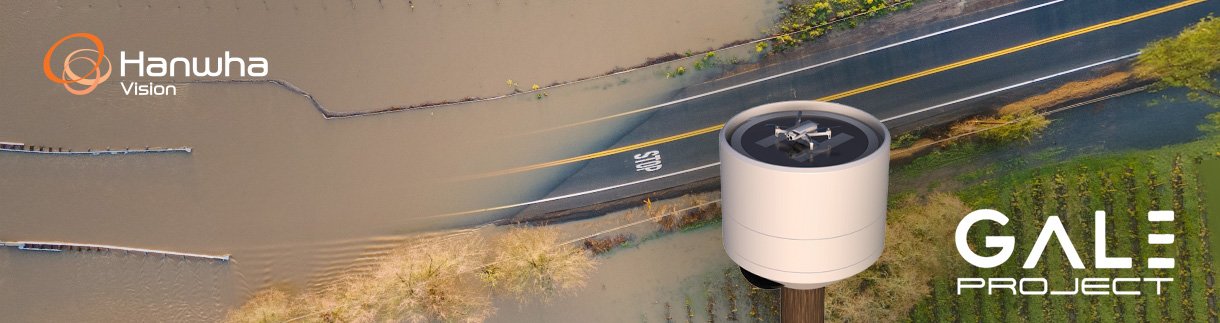
The GALE Project has a vision to reshape how municipalities and defense organizations approach public safety, security, and environmental data collection, by transforming existing fixed infrastructure into autonomous drone deployment hubs.
Founded by “serial entrepreneur” Jay Kriner, the early-stage company’s flagship GALE System is designed as an all-in-one platform, integrating remote active monitoring, an early alert system, and a drone deployment dock with Hanwha Vision pan-tilt-zoom (PTZ) cameras.
The GALE System is designed primarily for public safety, supporting fire and police departments with traffic monitoring, incident management, and license plate recognition capabilities. Secondary applications include Department of Defense (DoD) use cases such as base security and asset management. Beyond security, the system also supports environmental-related public safety efforts.
Kriner cited the 2025 Kerr County floods in his company’s home state of Texas as an example of a real-world scenario for his system. Enabled by Hanwha Vision AI-powered cameras, the system can be trained to monitor water levels, demonstrating its potential for environmental monitoring and providing early alerts.
“This system was designed specifically based off floods that we’ve been prone to in the past,” said Kriner, founder/CEO, GALE Project. “The early alert application is a massive opportunity, especially if we’re able to train the AI model to monitor water flow, water levels, and tides. And these cameras play a big part in that.”
“This system was designed specifically based off floods that we’ve been prone to in the past. The early alert application is a massive opportunity, especially if we’re able to train the AI model to monitor water flow, water levels, and tides. And these cameras play a big part in that.”
-Jay Kriner, Founder/CEO, GALE Project
The GALE System is a significant step forward in public safety technology, consolidating multiple surveillance and monitoring functions into a single, customizable platform. Its modularity is a key differentiator, allowing users to configure the system based on needs and budgets. Organizations can begin with cameras and sensors and then add the drone dock later as well as other third-party technologies.
A common configuration features the GALE System mounted on utility poles, but with its modular design and integration of Hanwha Vision’s PTZ cameras, Kriner noted the system has nearly unlimited potential in any application.
“Some people might want to monitor vegetation growth, while others might want to track bird migration patterns,” he said. “There are so many capabilities.”
A commercial rollout of a version without the drone component is anticipated by 2026, as the drone integration is the most time-intensive element of development. The company is planning to assemble a scaled prototype in the fall of 2025 with the Hanwha cameras included as an operational element, and GALE is opening another round of seed investments in November.
The GALE System combines a camera, sensor, and drone technology into a compact modular unit. The middle “auxiliary” section of the unit is designed to be “open-sourced,” enabling easyintegration of third-party technologies.
“When I say modular, just take our system and you can chop it into three sections depending on what the end user wants,” he said. “Maybe they don’t want a drone top on every single utility pole, but they do want the camera. It allows them to tailor to their needs.”
Technology Integration
The GALE Project chose to integrate Hanwha Vision PTZ cameras due to their advanced capabilities and turnkey design. Hanwha’s built-in AI and cloud solutions reduced development time and costs, enabling the GALE Project to accelerate time to market.
“Using Hanwha cameras cut production cost and efforts down tremendously by offering more flexibility, and it allowed me to come to market a lot faster,” he said.
Use Cases and Applications
Kriner positions the GALE System as a disruptive technology, consolidating the roles of multiple cameras while adding new capabilities. “You look up at a utility pole, and it’s got five-plus cameras facing different directions,” he said. “We’re reducing all that into one system and then adding additional features. We see the security aspect, the public safety drone, and its first responder applications. We’re the first to come to the market on this one.”
Partnership with Hanwha Vision
Hanwha Vision’s PTZ cameras were critical to the GALE System’s success. Kriner recalled visiting Hanwha’s Houston showroom, where he was shown a camera zooming in on an individual from a great distance, all capabilities essential for his clients. It was immediately clear that Hanwha’s advanced technology, combined with integrated AI and cloud support, would enable GALE to deliver a more flexible and efficient product.
Disruptive Technology Takes the National Stage
Kriner is keeping GALE visible on the national stage to showcase the company’s disruptive potential for enabling advanced real-time monitoring and AI-driven situational awareness capabilities. In September, he met with congressional members to represent the GALE Project and advocate for SBIR/STTR (Small Business Innovation Research/Small Business Technology Transfer) funding, which plays a vital role in accelerating innovative small businesses that are engaging in research and development with the goal of commercialization.
The company also attended the prestigious AFA Air, Space & Cyber Conference, engaging directly with senior leaders from the U.S. Air Force, U.S. Space Force, and the broader defense innovation ecosystem.
“At the end of the day we’re solving problems proactively instead of reactively,” Kriner said, “and everybody’s excited about a new technology that is on the forefront of public safety.”
At a Glance
Previous
Next