 Hanwha Vision Announces the Major Video Surveillance Trends in 2024
Hanwha Vision, a global vision solution provider, has announced the 2024 forecast for major trends in the video surveillance industry.The world of video surveillance has rapidly evolved in the past decade as technology improved. Simultaneously, the industry gained new opportunities for growth through the vigorous commercialization of products and services with cutting-edge innovations, such as AI and cloud technology.Video surveillance systems are no longer just for recording images, but have become an essential tool for businesses across the globe to improve operations, increase productivity, and enhance security. 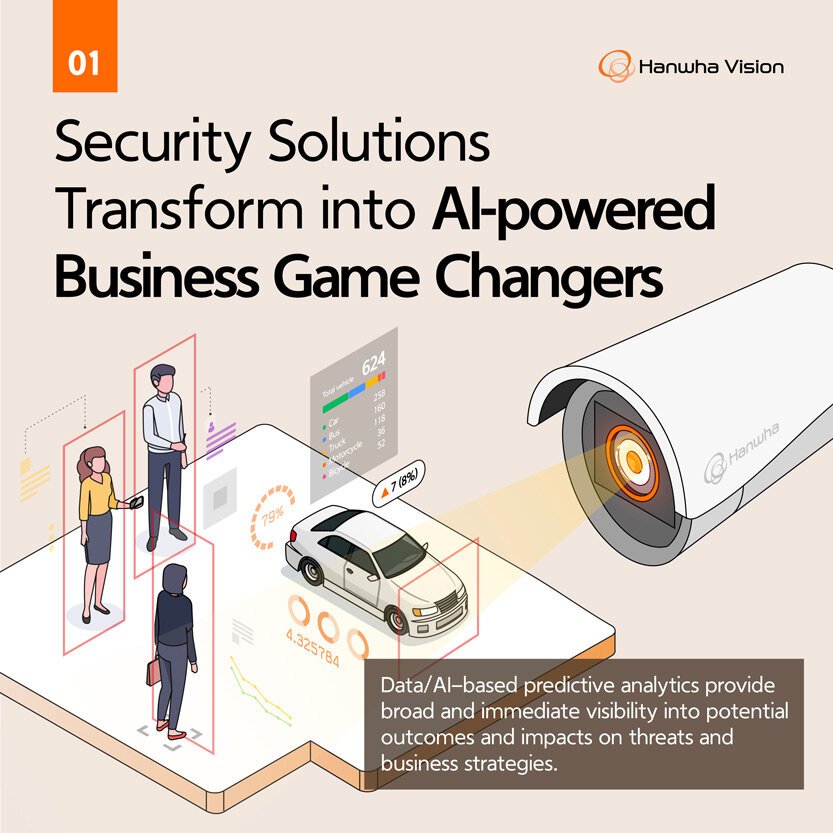
01 Security solutions transform into AI-powered business game changers
The integration of security cameras and AI has been a major topic in the video surveillance industry recently. Especially in 2023, the video surveillance industry has readily embraced AI technology as a new standard of operation, with widespread adoption across industries as the development of AI speeds up.Hanwha Vision predicted that by 2024, AI implementation would accelerate to provide data insights beyond post-response and pre-detection, including for event/incident analysis, future forecasting, and other applications.Seung In Noh, Head of AI Lab. at Hanwha Vision, said, "The industry is not only leveraging AI technology that accurately detects and distinguishes objects captured in security cameras, but also producing valuable insights for business through video data and AI-based analysis, and assessing the likelihood of specific events." He added, "These data and AI-driven predictive analytics provide broad and immediate visibility into numerous potential outcomes and impacts on threats and business strategies."AI-based predictive analytics in video surveillance consist of three large processes: video information collection, exploratory data analysis, and future situations modeling. These are used in industries such as urban infrastructure, retail, factories, logistics, and medical sites, and make businesses more efficient through cost reduction, process optimization, and service quality improvements, as well as safety and accident prevention.Hanwha Vision's SightMind, which was released as a pilot program to some select customers this year, visualizes metadata extracted from AI cameras and other IoT devices to help customers apply data to their businesses. The AI camera conducts a self-analysis and SightMind displays it through the dashboard as customizable widgets and charts. Compatible with a variety of apps, SightMind has a vast potential.For example, SightMind allows retail stores to effectively develop products and staffing plans by measuring advertising effects of digital signage and analyzing in-store customer traffic. The platform could also allow urban planners to detect the most congested times in a city center to reduce traffic or to gain the insights needed to open or close lanes. For factories, SightMind intuitively determines personnel decisions for certain shifts, and evaluates compliance with safety protocols, including: slip and fall detection, restricted area access monitoring, and proper use of helmets and other personal protective equipment.Hanwha Vision's SightMind is scheduled for official release starting in the North American region in 2024.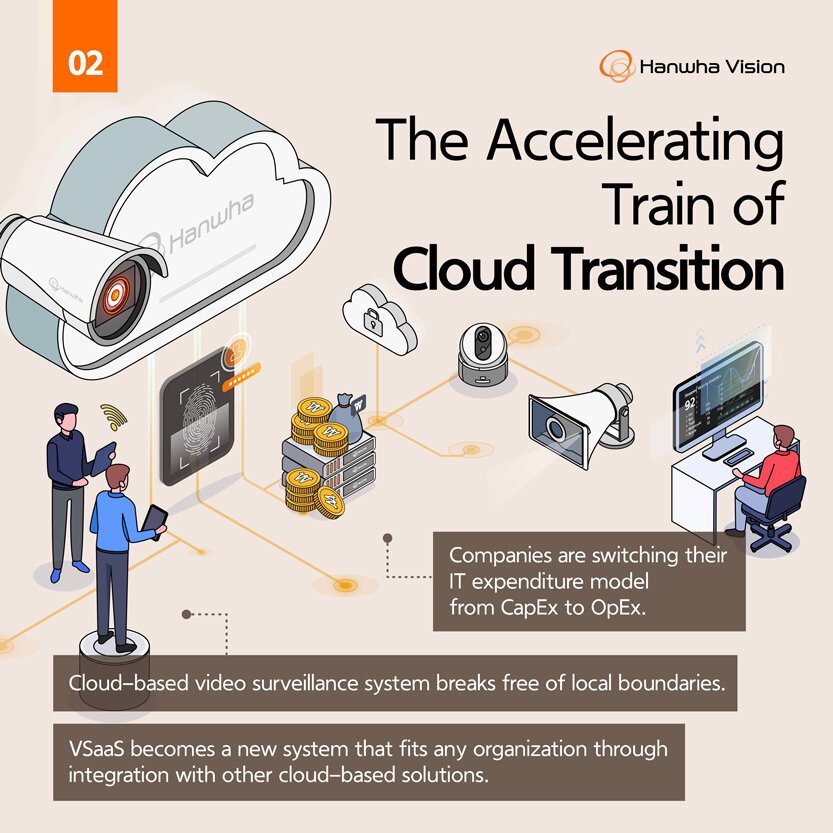
02 The accelerating train of cloud transition
After the benefits of cloud-oriented digital transformation were proven during the pandemic, user affinity for and trust in cloud-based services has increased significantly. This has had a huge impact on the video surveillance industry, which is actively seeking cloud-based services to effectively utilize data and cutting-edge technologies such as AI, and on the streamlining of business operating costs.Andy Jungwoo Ryu, Chief Product Officer at Hanwha Vision, explained: "Companies are increasingly investing in cloud-based services that take advantage of video data due to advanced video surveillance technology, increased initial investment costs, and current high interest rates." He added, "It is getting more obvious that an increasing number of companies are switching their IT expenditure model from CapEx to OpEx, and these changes accelerate the adoption of cloud technology."Given the uncertain economic and business environment, the pre-investment of an on-premises approach carries multiple risk factors. Building an on-premises server that requires predicting computing assets needed in the future can strain budgets or suffer from limited computing capabilities, depending on forecast accuracy and potential changes in computing demand. Cloud-based solutions, however, can adjust capacity as needed and stay on budget through usage-based spending. Many organizations are increasing their cost-efficiency through cloud services in annual/monthly subscriptions instead of opting for large initial investments.Hanwha Vision notes the increased demand for the remote management of multiple regions and diversification of integrable cloud-based solutions as other growth factors for cloud services in the industry.First, one of the reasons many organizations consider opting for cloud is that a cloud-based video surveillance system breaks free of local boundaries. Supervision and security can be maintained through the cloud anywhere in the world, even if operators are not physically available. Users can access live feeds and recorded videos through a web browser or mobile app even when they are traveling.A cloud-based video surveillance system, or VSaaS (Video Surveillance as a Service) can become part of a new system that fits any organization through integration with other cloud-based solutions. Many companies are already transforming how they use video surveillance systems by integrating them with security systems (access control, fire detection, building management, e.g.) and connecting them with AI/data analytics solutions.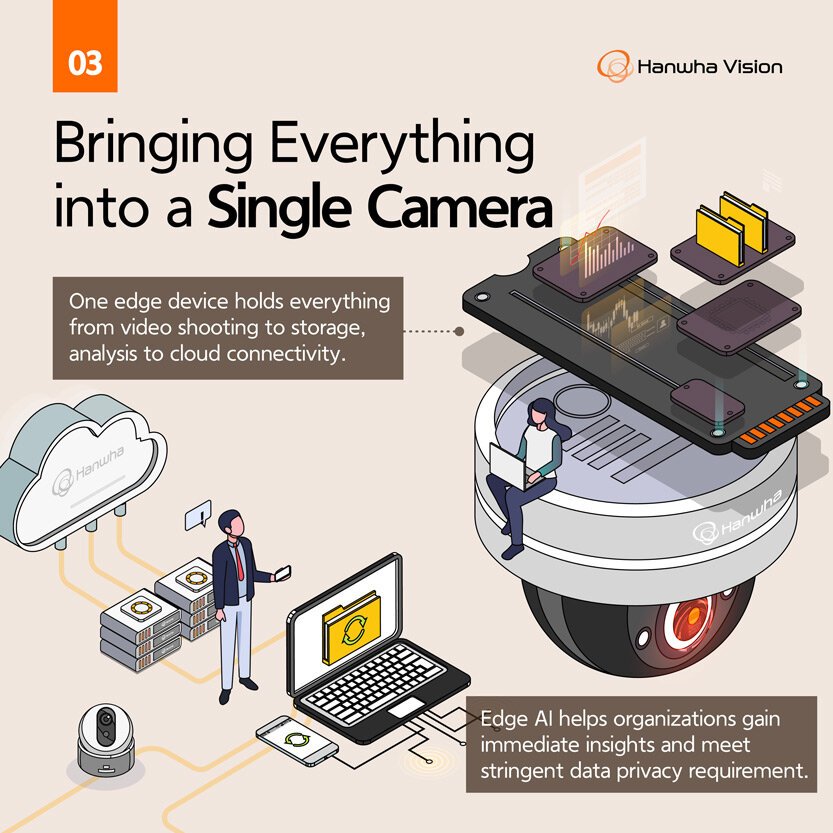
03 Bringing everything into a single camera
Streamlined data processing and management with lower overhead would be a dream come true for any organization. For this reason, customer expectations for edge AI, which revolutionizes the way we manage data, are rising day by day.Created from the combination of AI and edge computing, edge AI processes data when it is generated to help organizations gain immediate insights and meet stringent data privacy requirements. Companies can save time and money as large amounts of data do not need to be transferred to separate storage and processing locations.Market research firm Gartner predicts that by 2025, more than 55% of all data analysis by deep neural networks (DNNs) will occur at the point of capture in an edge system.For Seung In Noh, "ultimately, the biggest advantage of edge AI cameras is that video analysis takes place on-site, providing faster insights to facilitate real-time decision-making in critical scenarios." He added, "Although it is relatively recent that edge AI has been introduced in video analysis, it is noteworthy that the number of intelligent and edge AI-enabled cameras sold in the video surveillance market is rapidly increasing."Hanwha Vision continues to add more features to edge AI cameras in order to meet the needs of different verticals. Next year, more vertical-specific edge AI functions will be introduced. One example is retail-specific functions to detect abandoned or runaway carts and to send notifications and warnings to managers. Another example is factory-specific functions that check the location of forklifts and detect driving speeds to protect operator safety. Hanwha Vision is also preparing solutions to detect and classify sounds such as gunshots, explosions, and screams.Andy Jungwoo Ryu said, "Edge AI cameras can reduce investment and operating costs and streamline data processing and management. This is possible because one edge device holds everything from video shooting to storage, analysis to cloud connectivity, instead of requiring separate systems or infrastructure such as surveillance cameras, video storage and servers for AI analysis."Hanwha Vision's SolidEDGE is the first solid state drive (SSD)-based camera that hosts WAVE VMS servers on the camera itself, without a separate server. SolidEDGE allows each edge to add up to five cameras, allowing a total of six cameras per edge to operate on a single WAVE VMS server (on-premises). Combined with WAVE Sync (cloud), users can remotely manage up to 30 on-premises servers from anywhere in the world.