
Artificial intelligence (AI) is being rapidly adopted across industries, and its presence in everyday life is only growing. As conversations around AI continue to evolve, we wanted to explore how this powerful technology is showing up in American classrooms and what it means for the future of education in our country.
To understand how AI is really being felt in schools, we surveyed students, parents, and educators across the U.S. From concerns about cheating and teacher readiness to widespread support for AI literacy, the data reveals a nation navigating the promises and pitfalls of a tech-driven future.
Key Findings
Nearly 9 in 10 Americans fear deepfakes targeting their schools.
1 in 5 students admit to using AI to cheat, and most Americans want digital hall monitors
2 in 3 Americans (67%) say teachers aren't ready for AI in the classroom.
58% of teachers and 61% of parents say the best fix for teacher shortages is pairing AI with remote human instructors.
87% of Americans support teaching AI literacy in schools, with one-third saying it should start in middle school.
66% of parents say schools should always get consent before using student data with AI tools, signaling a growing demand for transparency and control in tech-powered classrooms.
Teacher Training Trouble: 67% Fear Educators Aren't Ready for AI
As AI tools flood classrooms, 2 in 3 Americans (67%) worry teachers aren't being trained to use them effectively. Parents (65%) and students (64%) largely agree, but the most concern comes from inside the schools themselves: 70% of teachers and administrators say they don't feel adequately prepared to use AI in the classroom.
While many educators feel underprepared, most Americans still believe AI can ease their workload. The majority support using AI for specific time-saving tasks like correspondence. 66% say it's appropriate for teachers to use AI to draft parent communications or reports, as long as they review the final message for accuracy and tone.
Still, not everyone is on board. Among those who oppose AI-written school communications,1 in 5 say it feels too cold and impersonal, and 13% believe that messages from schools should always come from a human being, no exceptions.
55% Want AI and Humans To Teach Together
Nearly 3 in 4 Americans (72%) believe AI can have a positive role in the classroom, especially for one-on-one tutoring or helping in large, understaffed classes. But even among supporters, one thing is clear: Americans don't want AI to replace teachers. Over half of educators (53%) say AI should only be used if teachers stay in control and remain central to learning, a view shared by many parents as well.
Among the 28% of Americans who view AI tutoring negatively, only 7% oppose AI in education altogether. For the rest – about 1 in 5 – the main concern is losing the personal connection and mentorship between students and teachers. That concern is echoed by 26% of teachers and 24% of parents.
So, where do Americans draw the line? When it comes to AI's role in the classroom, opinions vary depending on the task.
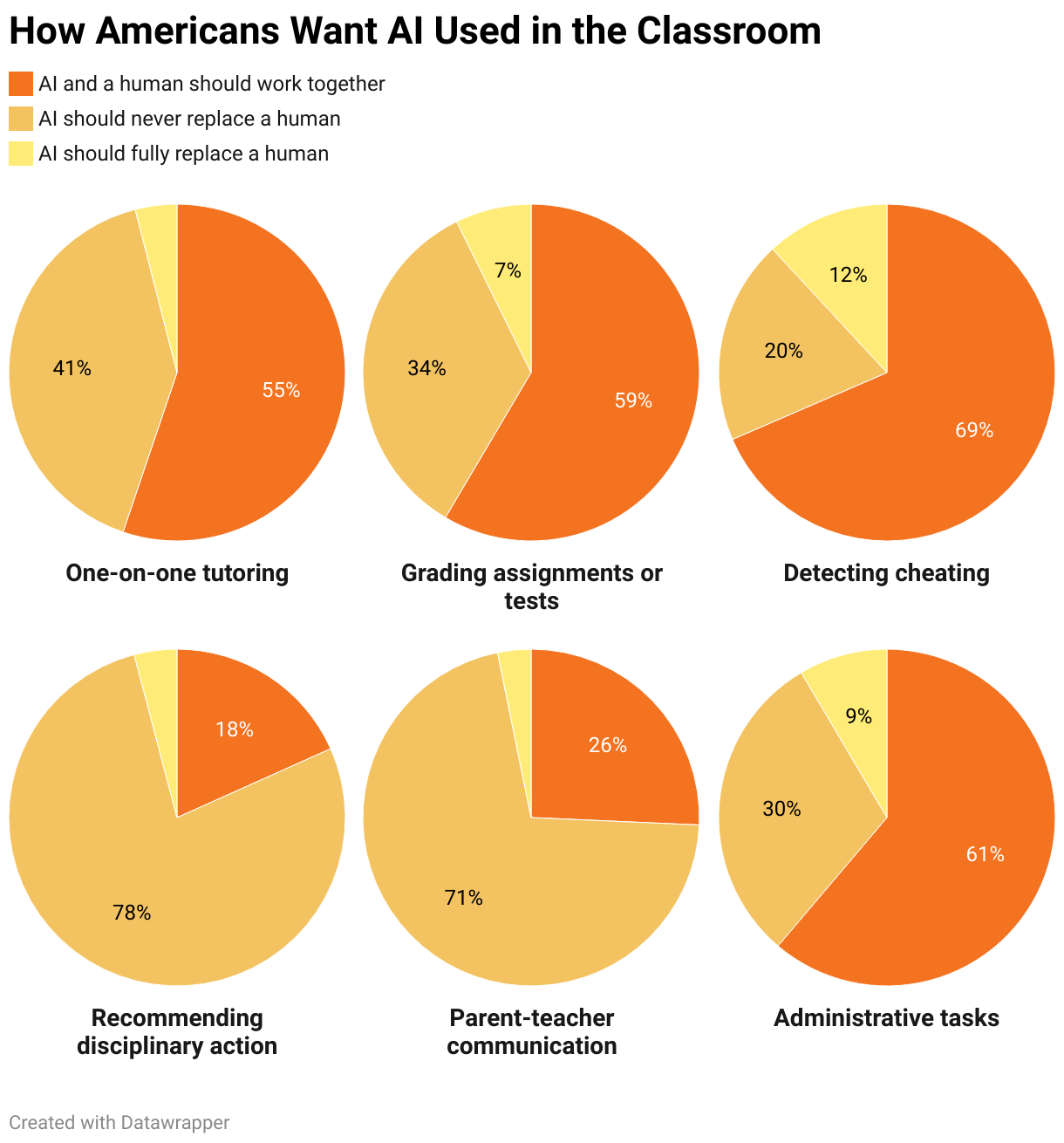
Across the board, most Americans agree on one thing: AI should be a support tool in classrooms, not a replacement for teachers. There's broad support for using AI to help with grading, admin tasks, and even detecting cheating. In fact, the majority of teachers, parents, and students all say AI and humans should work together on these tasks, not separately.
But when you dig into each group's perspective, the differences start to show. Students are the most open to AI-led learning: 1 in 3 say it's fine for AI to handle one-on-one tutoring on its own. But they're also the most skeptical when it comes to enforcement: 26% say AI should never be in charge of detecting cheating, compared to just 13% of teachers. And while teachers and parents are open to using AI for support, they draw a firm line at more personal responsibilities – nearly 80% say AI should never handle discipline or communication with parents directly.
But challenges like chronic teacher shortages make the conversation more complicated. With schools struggling to find enough qualified educators, Americans are already thinking about how AI might help. Here's what they believe schools should do next:
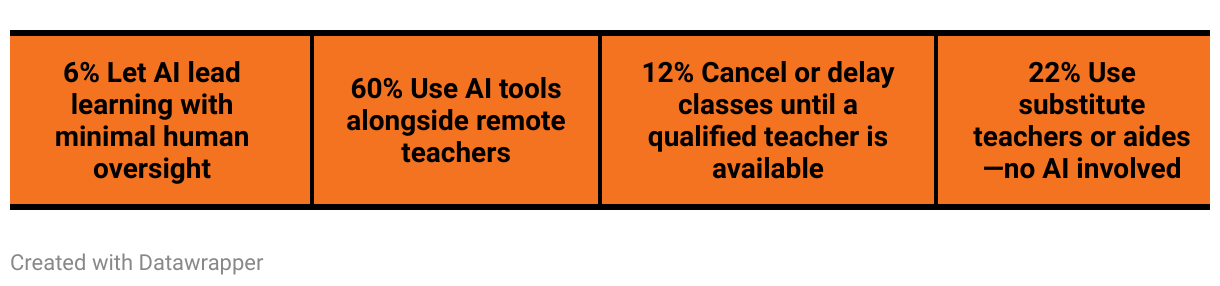
Even as hybrid instruction gets broad support, not everyone's comfortable with AI stepping in for teachers. 1 in 10 parents – and a similar share of teachers and students – say they'd rather cancel or delay classes than rely on AI alone during a staffing shortage.
Many would still rather wait for a real person. 1 in 4 teachers and nearly 1 in 4 parents say they prefer substitutes or aides over AI. Meanwhile, 58% of teachers and 61% of parents say the best solution is using AI with remote human teachers, not instead of them.
20% of Students Admit to AI Cheating – Fueling 80% Support for Security & Digital Hall Monitors
As AI tools like ChatGPT make their way into classrooms, Americans are split on where to draw the line. About 1 in 3 (32%) say using AI to complete assignments is flat-out plagiarism. On the other end, fewer than 1 in 10 see no issue at all, viewing AI more like a calculator or spell-checker: a helpful tool, not a way to cheat.
But most Americans fall somewhere in the middle. Nearly 6 in 10 parents, students, and teachers agree: using AI for schoolwork isn't automatically plagiarism – it depends on how it's used and whether the student acknowledges it.
So, are students actually cheating? Here's what students have to say:
20% say their AI use is clearly cheating or plagiarism.
25% say it's a gray area that might cross the line.
20% haven't used AI for schoolwork at all.
Schools aren't powerless against AI misuse either. In fact, 4 in 5 Americans support using AI to detect cheating, showing strong public backing for holding students accountable with the same tools that can help them learn.
Still, trust in AI's judgment has limits, especially among parents. Just over half (54%) say they're comfortable with AI handling tasks like grading, cheating detection, or behavior monitoring. The rest remain skeptical, revealing a clear divide in parental confidence.
Very few support removing humans from the equation entirely. Only 11% of teachers, 13% of parents, and 12% of students say AI should handle cheating detection on its own. But when paired with people, trust grows: 76% of teachers, 67% of parents, and 62% of students say AI can be effective if it works alongside a human.
AI support extends to other areas of student oversight, too:
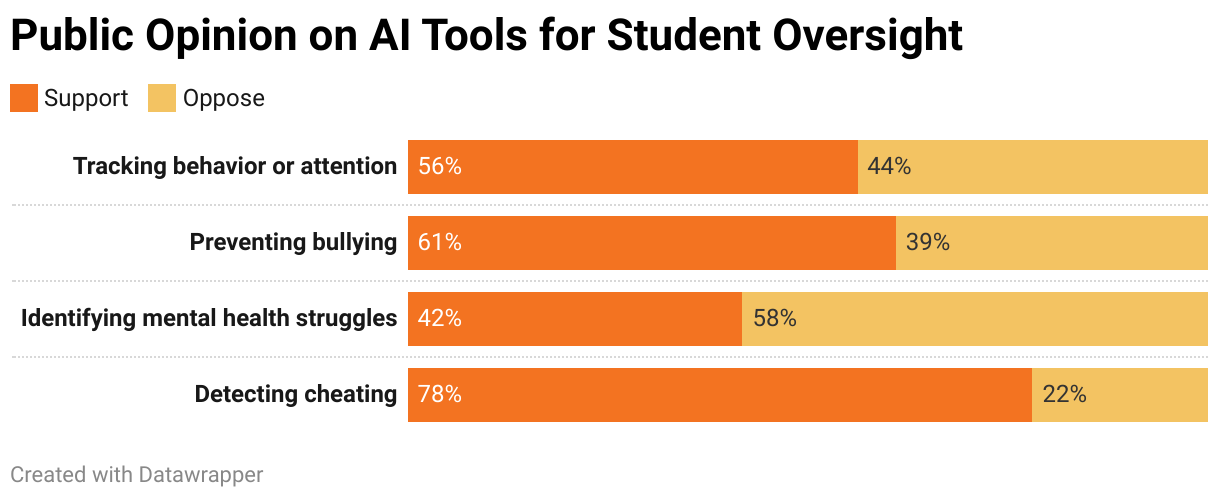
Parents are most supportive of using AI to prevent bullying, with 61% in favor and 39% opposed. They're also aligned with teachers when it comes to monitoring behavior and attention: 59% of both groups support it, while 41% do not.
Mental health is more divisive. Students are the most open to using AI for mental health support, but even then, only 43% are in favor and 57% oppose it. Teachers are the most resistant here. 61% oppose using AI to help students with mental health struggles, and just 39% support it.
Generational divides show up here, too. 2 in 3 baby boomers support using AI to prevent bullying, compared to just 57-58% of younger generations. On the flip side, nearly half of Gen Z (48%) support using AI to detect mental health issues, while only 38% of Gen Xers and baby boomers feel similarly.
Deepfakes in the Classroom? 89% are Worried
Another major concern around bringing AI into classrooms is how it could be misused. 89% of Americans say they're worried about someone using AI to create deepfake videos or images of students or school staff, pointing to broader fears about digital safety and abuse in school settings.
As AI becomes more common in education, Americans are concerned about the following potential cybersecurity and privacy risks in schools:
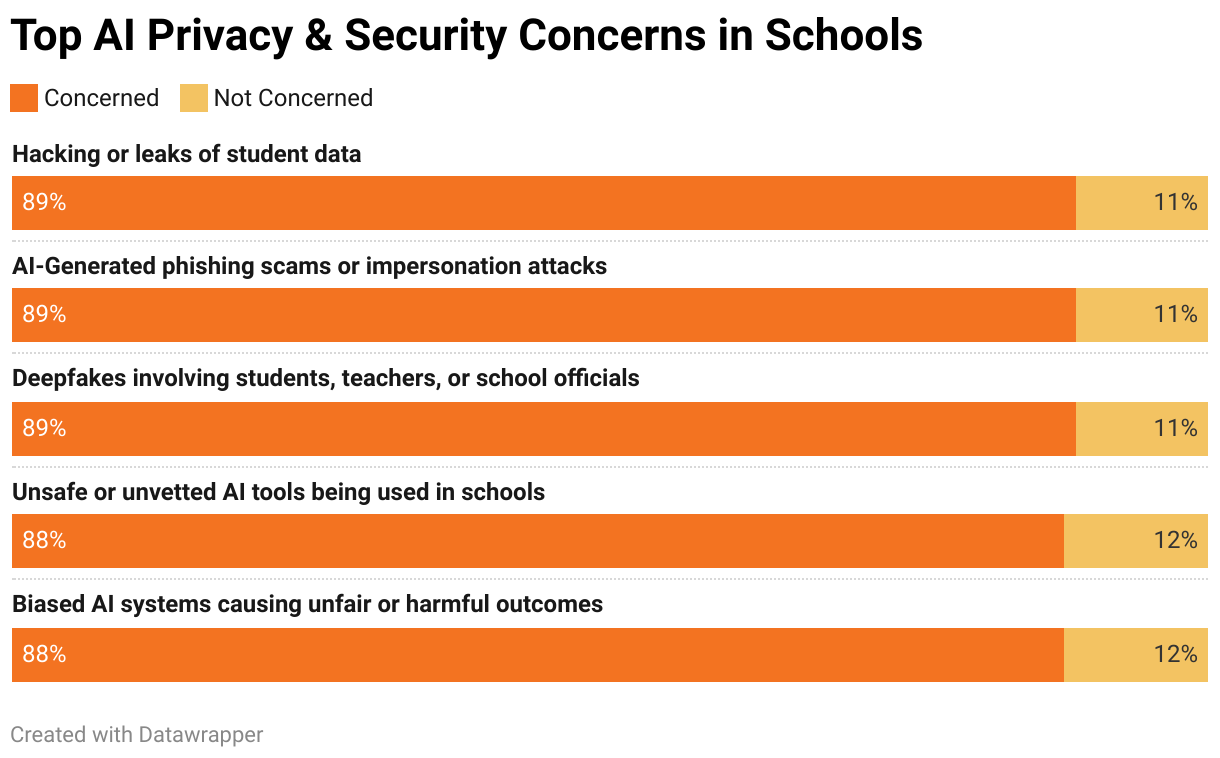
Teachers are the most concerned about AI deepfakes in schools – 60% say they're very worried about the technology being used to create fake images or videos of students or staff. More than half of students and parents share that concern, making deepfakes the top AI-related fear across all groups.
These statistics reflect a growing belief that cybersecurity is as essential to modern schools as physical safety measures like advanced surveillance systems. With online integration, protecting students means guarding them from both physical and digital threats.
Americans Are Already Experiencing the Risks
For many, these concerns aren't hypothetical – they're personal. Two-thirds of Americans (66%) say they've either been the victim of an AI-driven scam or know someone who has. Here's how those experiences break down:
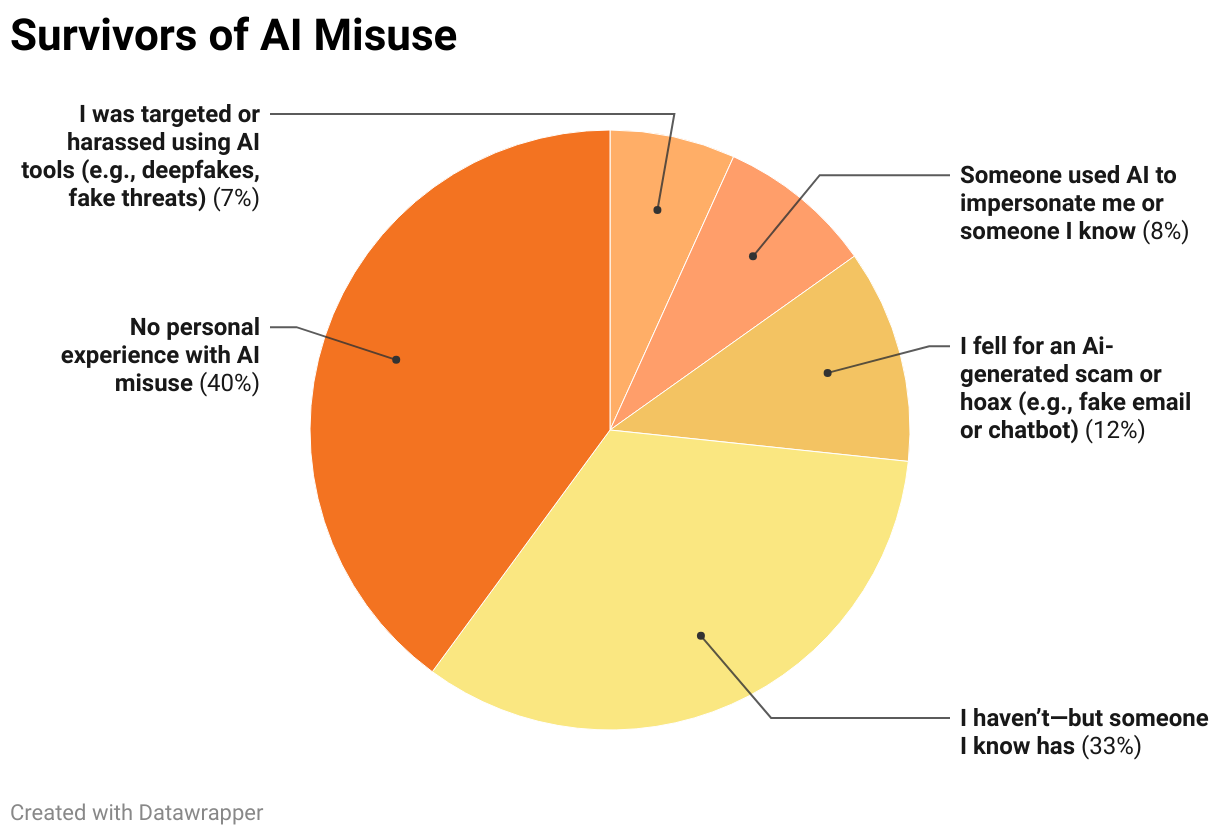
While AI scams impact people across the board, students are far more likely to say they've been deceived. 1 in 5 students (20%) report falling for an AI-generated scam – nearly three times the rate of parents and teachers (both around 8%).
Students also face AI harassment, such as fake images or threats, at double the rate of adults. Altogether, 2 out of 3 students (67%) say they've experienced some form of AI-related harm, making them the most at-risk group compared to parents (53%) and teachers (48%).
With so many potential risks, it's no surprise that 95% of Americans want schools to obtain student or parental consent before using their data is for AI-powered education tools.
65% believe consent should always be required, regardless of the tool.
30% say consent should be necessary only when a tool presents a clear risk.
Only 5% say consent isn't necessary.
Nearly 2 in 3 across all groups – 66% of parents, 63% of students, and 65% of teachers – say explicit consent should always be required before a student's data is used by AI-powered education tools, underscoring strong public demand for privacy and transparency in how school tech is deployed.
Who Should Govern AI in Schools? Americans Favor Local Control, but Want Oversight
With a clear demand for AI regulation, the question becomes: Who should be in charge of making sure it's used safely and effectively in schools? Most believe education leaders should take the lead, with 3 in 5 saying state education departments should set rules and policies for student AI use.
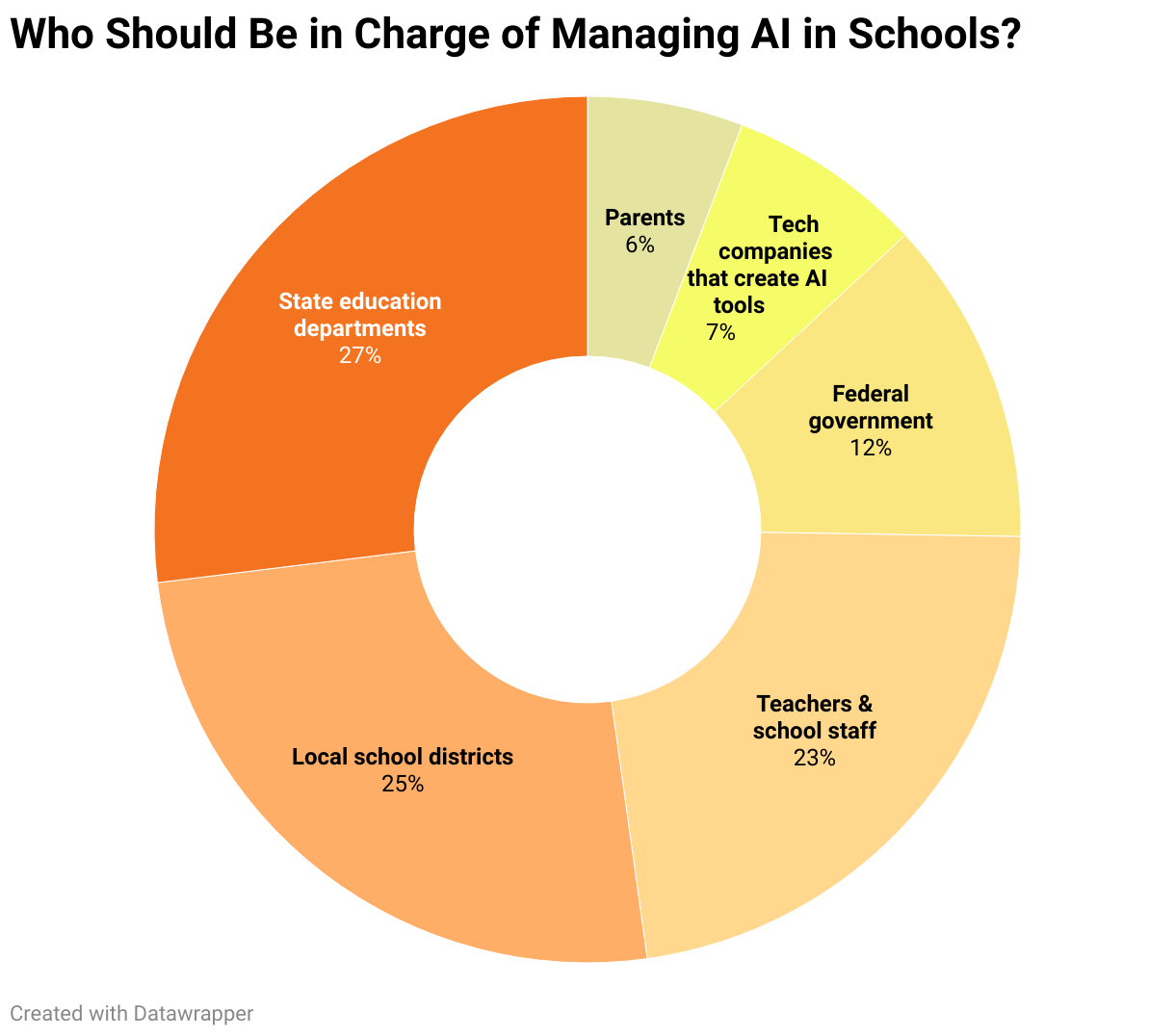
State education departments topped the list for students, parents, and teachers, with the majority – 61% to 63% – agreeing that state-level leadership should guide AI policy in schools.
While 73% of Americans are satisfied with how their local schools are handling AI, that doesn't mean they're opposed to federal oversight. For many, satisfaction comes with strings attached, like national standards, safeguards, or accountability measures.
45% are satisfied and trust local schools to handle AI without federal involvement.
28% are satisfied, but still want federal oversight.
11% are dissatisfied and want stronger federal protections.
15% don't trust local or federal officials at all.
Nearly half of students (49%) and parents (48%) say they trust their local schools to handle AI without federal oversight.
Teachers are more disillusioned and share the highest level of concern among students and parents: Nearly 1 in 3 say they don't trust their local administration to manage AI responsibly.
Public vs. Private: Should AI Rules Be Universal?
The debate over AI oversight also extends to the public versus private school divide. A clear majority – 64% of Americans – say AI rules should apply to all schools, regardless of type.Support is especially strong among educators: 70% of teachers and 61% of parents believe private schools should follow the same AI standards as public ones, reinforcing the call for consistent oversight across the board.Others hold a more flexible view. 17% of Americans believe private school students and parents should be able to opt out of public school policies. And about 1 in 5 say private schools should have complete autonomy to set their own AI guidelines.
Teaching Sensitive Subjects: Can AI Handle the Nuance?
Using AI in the classroom also affects the way sensitive topics like race, gender, and U.S. history are taught. This is especially relevant given that some school districts and states are choosing to move away from diversity, equity, and inclusion (DEI) programs.More than 2 in 5 Americans (41%) say human teachers are best suited to teach topics like race, gender, and U.S. history, citing the importance of lived experience and the ability to navigate sensitive conversations. But beneath that agreement, public opinion is more divided than it seems.
19% say it depends – both teachers and AI need the right training.
13% think AI may teach better than teachers – no human bias.
13% believe AI can teach DEI concepts without setting off political alarms.
13% believe anti-DEI policies make honest education impossible.
Half of teachers say only human educators should teach sensitive topics like race, gender, and U.S. history, putting lived experience at the center of DEI-related learning. Just 35% of parents agree.But students aren't looking to people alone. 1 in 3 say AI should be the one to teach these topics – more than any other group. Fewer than 1 in 5 teachers agree, revealing a generational split over who belongs at the front of the classroom when it comes to identity, history, and trust.
How Can AI Help Students? Americans See Personalized Support as the Top Benefit
Most Americans agree AI has the potential to help students. Here's where they think an AI tutor would be most helpful:

Notably, 1 in 5 students (22%) want to use AI tutors for emotional support, which is double the rate of teachers (12%).
Parents aren't as on board with that idea. Only 15% say AI tutors should provide emotional or motivational support. Instead, most parents (56%) see AI as more of a study buddy than a source of emotional connection, preferring it to offer tips and encouragement rather than take on a relational role.
Opinions differ, however, on who benefits most from AI-powered tutoring:
Students learning English or who speak multiple languages : 29%.
Struggling students who need extra support beyond what human staff can provide : 29%.
Shy or socially anxious students : 19%.
Neurodivergent students : 18%.
Gifted or advanced students who need more challenging material : 17%.
AI can help all students, regardless of background or need : 41%.
Nearly 1 in 3 teachers, students, and parents say multilingual learners stand to benefit most from AI tools – more than any other group, including struggling, shy, or neurodivergent students.
When asked why AI should be used in education, Americans consistently return to three main benefits:
Personalization : The ability to tailor content and pace to each student's individual needs.
Teacher support : Automating time-consuming tasks so educators can focus more on teaching.
Educational equity : Offering underserved students access to higher-quality resources and learning opportunities they might not otherwise receive.
Teachers, parents, and students see the benefits of AI in education. More than 1 in 4 teachers say their top hope for AI in schools is reducing burnout by offloading time-consuming tasks like grading and admin work. Roughly 1 in 3 parents and students hope AI in schools can lead to more personalized learning tailored to each student's unique pace and needs.
79% Won't Pay Extra for AI Schools, but 55% Reject Firing Teachers
Most Americans see the benefits of AI in classrooms, but that support drops fast when cost comes into play. A strong majority, 4 in 5 say they wouldn't pay extra tuition for a school that fully integrates AI. Only 14% say they'd pay up to $1,000 more per year, and just 7% are willing to go beyond that.
But not everyone is opposed. Students are the most willing to invest, with 1 in 3 saying they'd pay out of pocket for an AI-powered education. Parents are more cautious -18% say they'd pay more, but most draw the line at $1,000 annually.
While more Americans oppose replacing teachers with AI to save money – 55% say it's completely unacceptable – nearly 1 in 5 think it's a good idea. 13% say it's acceptable if student performance doesn't decline, and 4% believe it's a smart, future-focused move.
As you'd expect, teachers are the most resistant. After all, their jobs are at stake. But surprisingly, 3 in 10 teachers aren't opposed to being replaced by AI.
Among parents, 1 in 7 say it's acceptable as long as academics don't suffer. And 1 in 5 students are on board, showing growing generational support for AI stepping into the classroom.
AI Literacy or Bust: One-Third Want Classes by Middle School – Usage Already Tops 30% Weekly
61% of people already use ChatGPT or similar AI tools for school or learning-related activities, but how often do we?
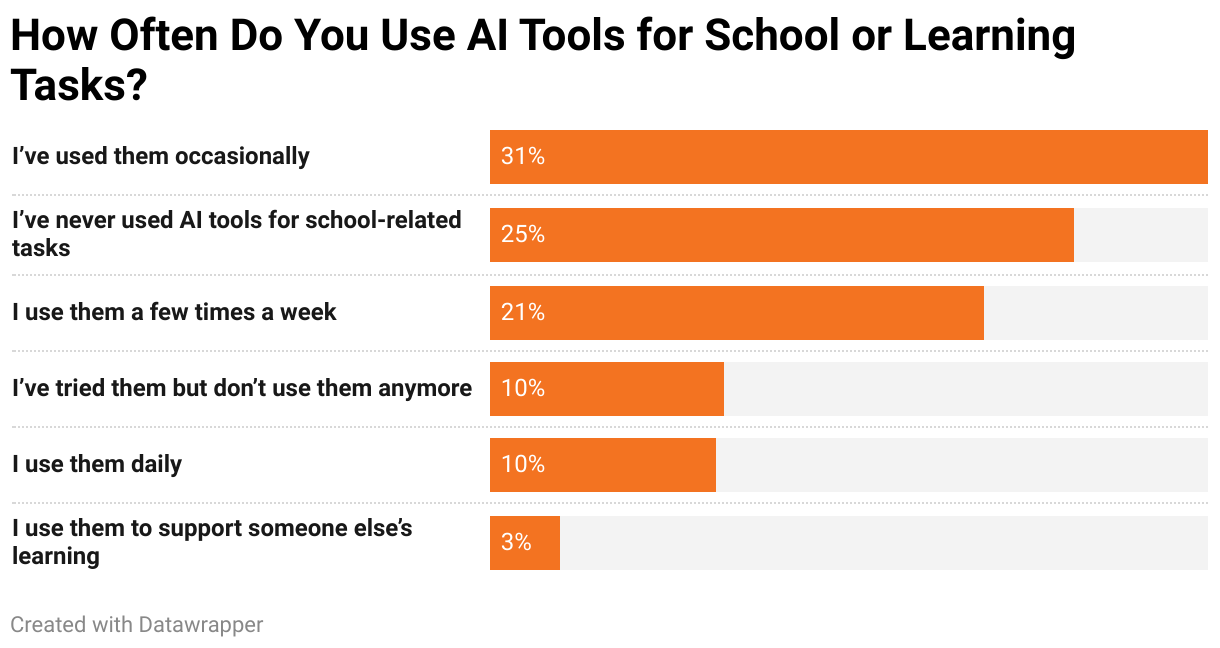
With AI tools like ChatGPT becoming part of daily life, 87% of Americans say AI literacy should be taught in schools, but they're not all aligned on how. 67% want it to be part of the required curriculum, while another 20% say it should be offered as an elective.
Among those who want AI taught in schools, most say it should start early. One-third (33%) believe AI education should begin in middle school, while 16% want it introduced starting in elementary school. Only 18% say it can wait until high school.
That urgency is shared by educators and parents – 1 in 3 say AI literacy should start in middle school. Students, however, are less concerned about early exposure, with 1 in 4 preferring to wait until high school to begin learning about AI.
Beyond just being familiar with AI, many Americans see it as essential for future success. Over half (54%) say embracing AI is key to staying ahead, while rejecting it could mean falling behind in school, work, and life. Parents lead the way, with 56% saying AI is instrumental for future success, followed closely by 55% of teachers and 51% of students.
9% are worried they'll fall behind if they ignore AI, while 16% want to adopt it to gain a competitive edge in the job market.
Students are more than twice as likely as parents or teachers to believe that rejecting AI will cause them to fall behind, suggesting they feel the highest personal stakes when it comes to adapting to AI.
Yet enthusiasm is tempered by caution. While many hope AI can ease teacher workloads and support student success, concerns about cheating, deepfakes, cybersecurity, and job loss remain top of mind. These mixed feelings reflect a broader reality: Americans are still figuring out where they stand on AI in education. As classrooms evolve, so do the conversations among students, parents, and teachers alike about the role of AI and the future being shaped.
Methodology
Hanwha Vision surveyed 1,000 Americans in 2025 to explore perspectives on artificial intelligence and technology in education. Of the respondents, 34% were students, 33% were parents, and 33% were educators-including teachers, professors, and school administrators. This even distribution allowed for an inclusive analysis of how different roles within the education system view emerging technologies. Figures may not total 100% due to rounding.
The balanced demographics also allowed us to understand how people from different generations, places, and income levels felt about AI. The way we organized the survey allowed us to zoom in and look at specific groups and also zoom out and look at the country as a whole.
We also wanted to look beyond whether or not AI should be used in schools. To accomplish this, we asked people how they would like schools to deploy AI, how they should monitor it, and how schools should pay for this new technology.
Fair Use Policy
Readers are welcome to use the analyses and findings from this study for noncommercial purposes, such as academic research, educational presentations, and personal reference. However, when referencing or citing this article, please ensure proper attribution. Direct linking to this article is permissible and encouraged to provide readers with access to the primary source.
For commercial use or publication purposes – including but not limited to media outlets, websites, and promotional materials – please contact the authors for permission and licensing details. We appreciate your respect for intellectual property rights and adherence to ethical citation practices. Thank you for your interest in our research.
Previous
Next